30 / 10 / 2026
📰 The Good News Gazette: why we need better stories about the future
An article by the ABR team in Sigmalive, told here in English
A newspaper from 2035, an Englishman from 1516 and a philosopher from Kition walk into a bar…
Open a newspaper. Count the disasters. Then open Netflix and count how many series about the future have a happy ending. How many did you find?
We have seen, heard and read the end of the world a thousand times. Climate collapse, robots taking our jobs, cities underground. And to round it off, the familiar “nothing will ever change”. A future where things went well? That’s where we get stuck. We find it naive. Or boring. Or simply impossible.
So much so that it is easier to imagine the end of the world than a street in Nicosia without cars.
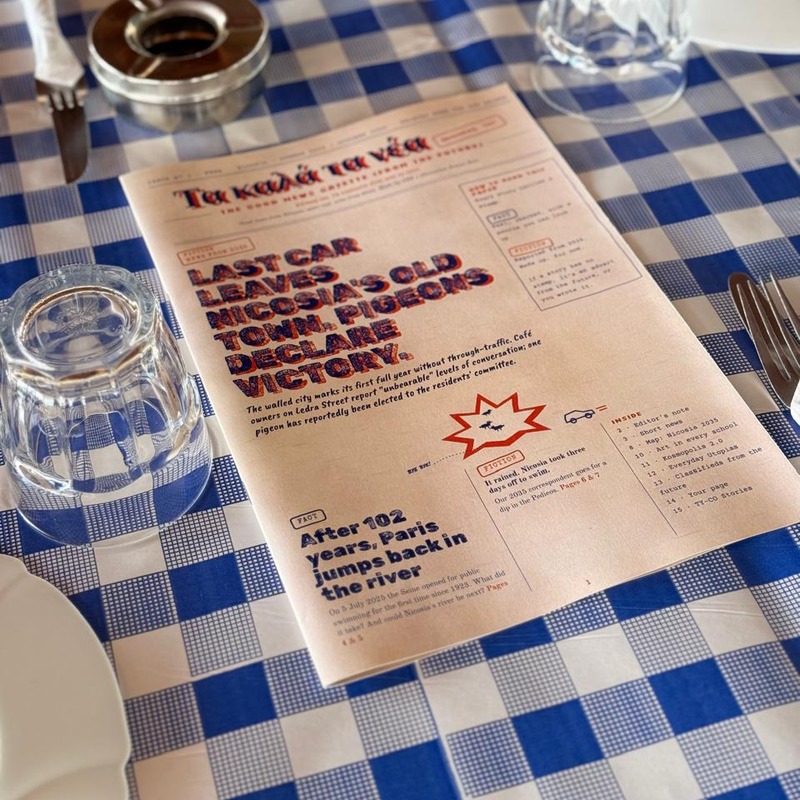
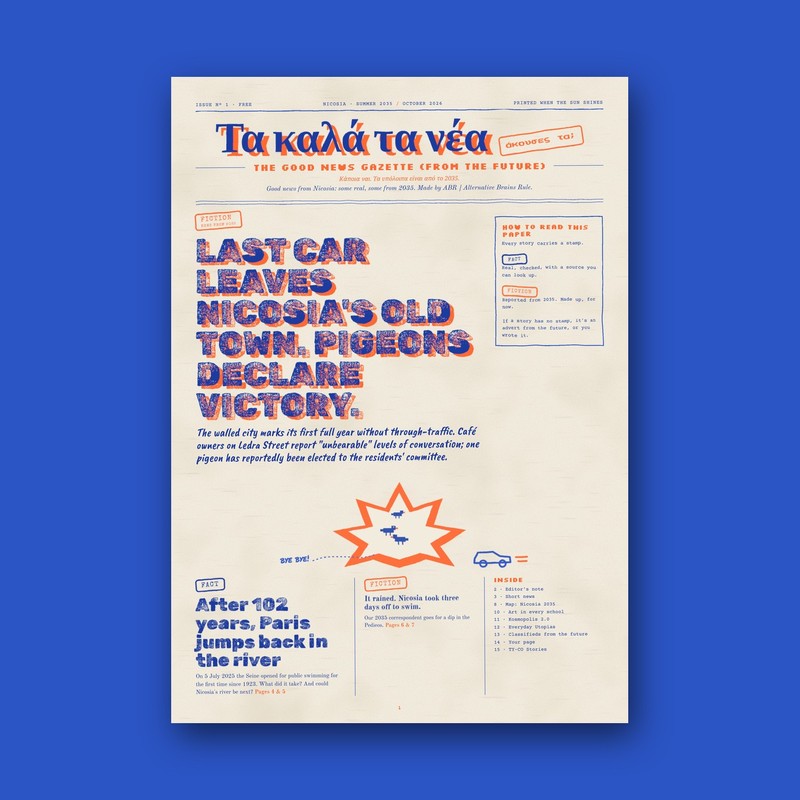
That’s why we made the newspaper Τα καλά τα νέα (The Good News Gazette). Did you hear? Meet the paper →
No-place or good place?
“Utopia” is a Greek pun. Thomas More invented it in 1516, for an island where everything works the way it should. He even gave it its own alphabet and its own poem, to make it feel real. Ou-topos, the place that does not exist. But change one letter and it could have been eu-topos, the good place. From the start, utopia comes with a question: does it exist anywhere, or only in our heads?
Before More, there was a Cypriot. Zeno of Kition, founder of Stoic philosophy, wrote his own Republic: a community where all people are citizens of the same world, not divided into cities and camps. A utopia made in Larnaca, around 300 BC. On an island that knows very well what division means, that is no small thing.
Imagining other worlds was never escapism. It was a way to see your own a little more clearly.
The century of dystopias
Somewhere in the 20th century, utopia lost the game. In 1932 Aldous Huxley wrote Brave New World, where everyone is controlled through pleasure and pills. In 1949 George Orwell wrote 1984, where everyone is controlled through fear and screens. Two different nightmares. Come to think of it, our phones do both.
In 1993 Octavia E. Butler wrote Parable of the Sower, which begins in 2024, in a California of wildfires, water shortages and gated neighbourhoods guarded day and night. When the real 2024 arrived, many people reread it and weren’t laughing. Since 2011, Black Mirror has shown us, episode after episode, how every new technology can go wrong.
These stories are a society’s alarm bells, and we need them. But when the alarm rings all the time, at some point we stop hearing it. Dystopia becomes normal. And the future becomes something that simply happens to us, not something we make.
When imagination becomes a plan
Science fiction doesn’t just predict the future. Often it designs it.
In 1945 Arthur C. Clarke wrote about satellites that would stay “fixed” above the Earth and relay signals around the planet. Today that is where television satellites orbit, and the orbit is also called the “Clarke belt”.
In 1982 William Gibson coined cyberspace. In 1992 Neal Stephenson coined the Metaverse, in Snow Crash. Both wrote about dark worlds nobody would want to live in. And yet their words became reality. In 2021 Facebook renamed itself Meta. The warning became a business plan.
We don’t need to look far to see it. One evening around the ABR table, someone made a prediction: one day a big music platform will stop paying musicians. It will use AI to make a song just for you, tuned to your taste. No royalties, no artists, more profit. It sounds like an episode of Black Mirror. Somewhere, someone is probably reading it as a strategy.
The antidotes
If stories design the future, then we need other stories too. Good news: they exist.
In 1974 Ursula K. Le Guin wrote The Dispossessed, subtitled “an ambiguous utopia”: a world that tries to live differently, with its problems laid out on the table. In 2014 she said something we keep pinned to the wall: Any human power can be resisted and changed by human beings. Resistance and change often begin in art.
In 2011 Stephenson himself, the man behind the Metaverse, wrote that science fiction had stopped giving us big, optimistic ideas to build. That led to Project Hieroglyph, a collection of stories about a better future. In 2020 Kim Stanley Robinson wrote The Ministry for the Future, which opens with a deadly heatwave and continues with decades of hard work that finally pays off.
There is also solarpunk, which imagines cities with gardens on the rooftops, energy from the sun and neighbourhoods where people know each other. Rob Hopkins of the Transition Towns movement puts it more simply: every change begins with a “what if…?”
None of these stories hides the crisis. They just don’t stop there. Because optimism doesn’t mean pretending you can’t see the danger. It means looking it in the eye and writing a different ending.
OPTIMISM DOESN’T MEAN PRETENDING YOU CAN’T SEE THE DANGER
Our own small eutopia
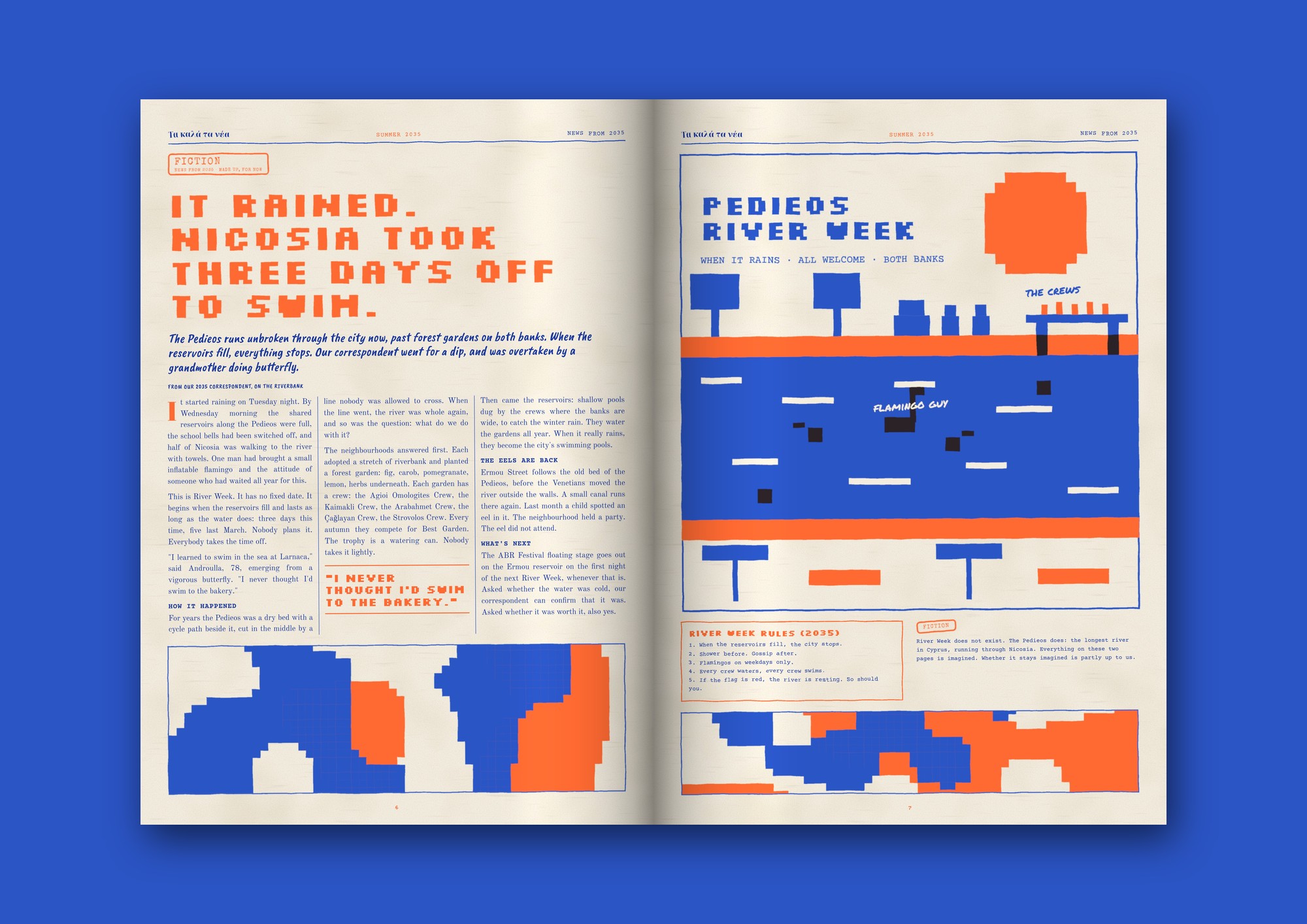
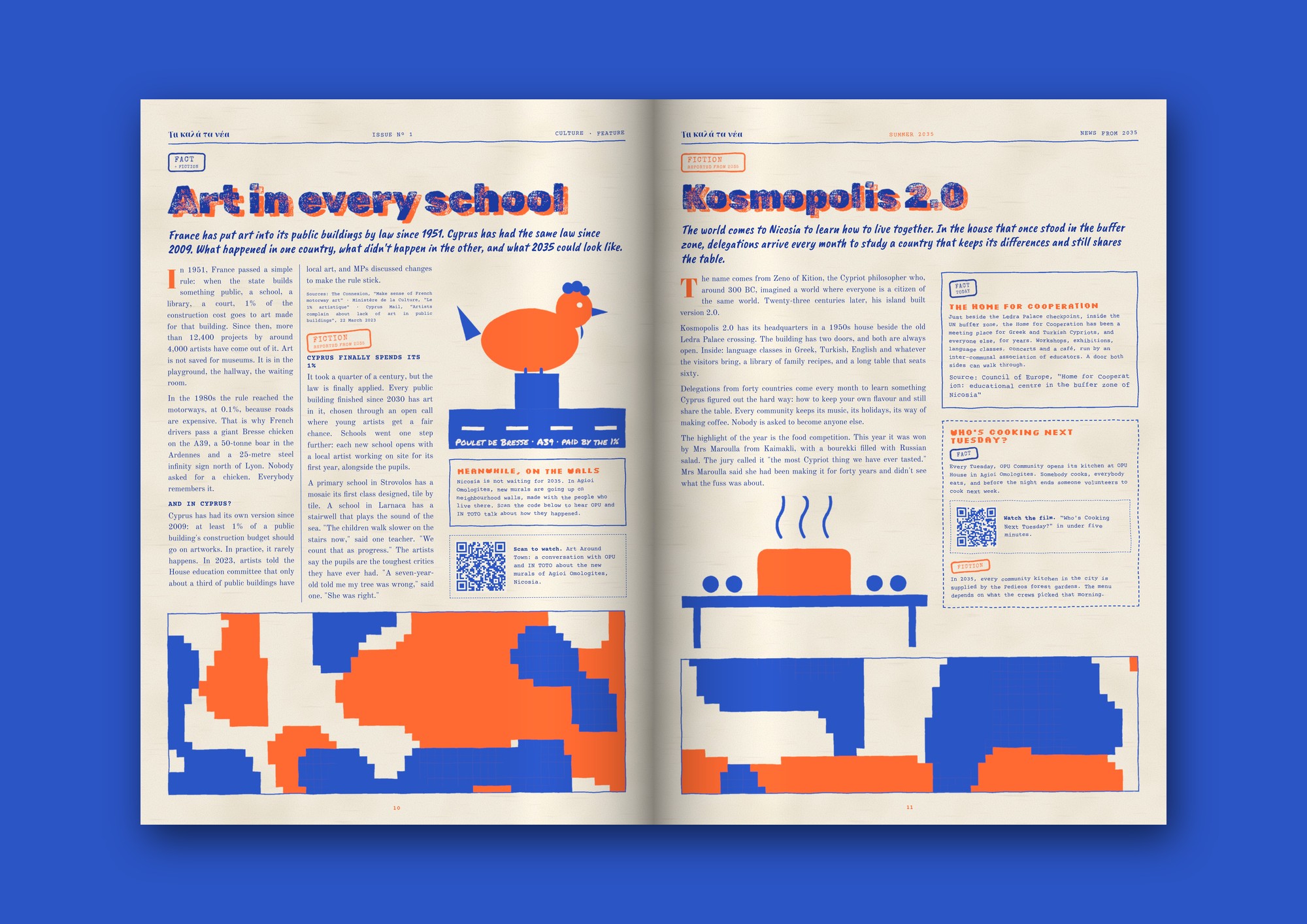
Τα καλά τα νέα is our own “what if…?”. Sixteen pages of good news: some real, some from 2035. Every story carries a stamp. FACT: we checked it, and you can check it too. FICTION: we imagined it, on purpose.
The surprise? How close the two are. In Paris, people have been swimming in the Seine again since 2025, after 102 years of prohibition. In Barcelona, superblocks gave the streets back to people. In Ireland, 2,000 artists now have a basic income, and in France every new public building has had art inside it since 1951. Nicosia is already walkable, as OPU’s map shows.
And we are not naive. The good news in our pages sits next to wars, heatwaves, rents nobody can afford and a city still divided in two. We don’t hide them. We simply refuse to accept that they are the only story.
Remember the prediction about music? In the paper we gave it a different ending. The plan fails, because nobody can sing along with a friend to a song nobody else has heard. Subscriptions fall, and in a small bar in Nicosia a band plays one song to forty people at once. “Strange”, said those who were there. “And really nice.”
The paper is on paper. No algorithm chooses what you see. Inside you’ll find QR codes for TY-CO’s films, conversations and podcasts. And a whole page is yours.
Write the headline you want to read in 2035. Take a photo of the page and send it to us on Instagram, @alternativebrainsrule, or to projects@abr.cy. The best ones will go on the blog and into the second issue.
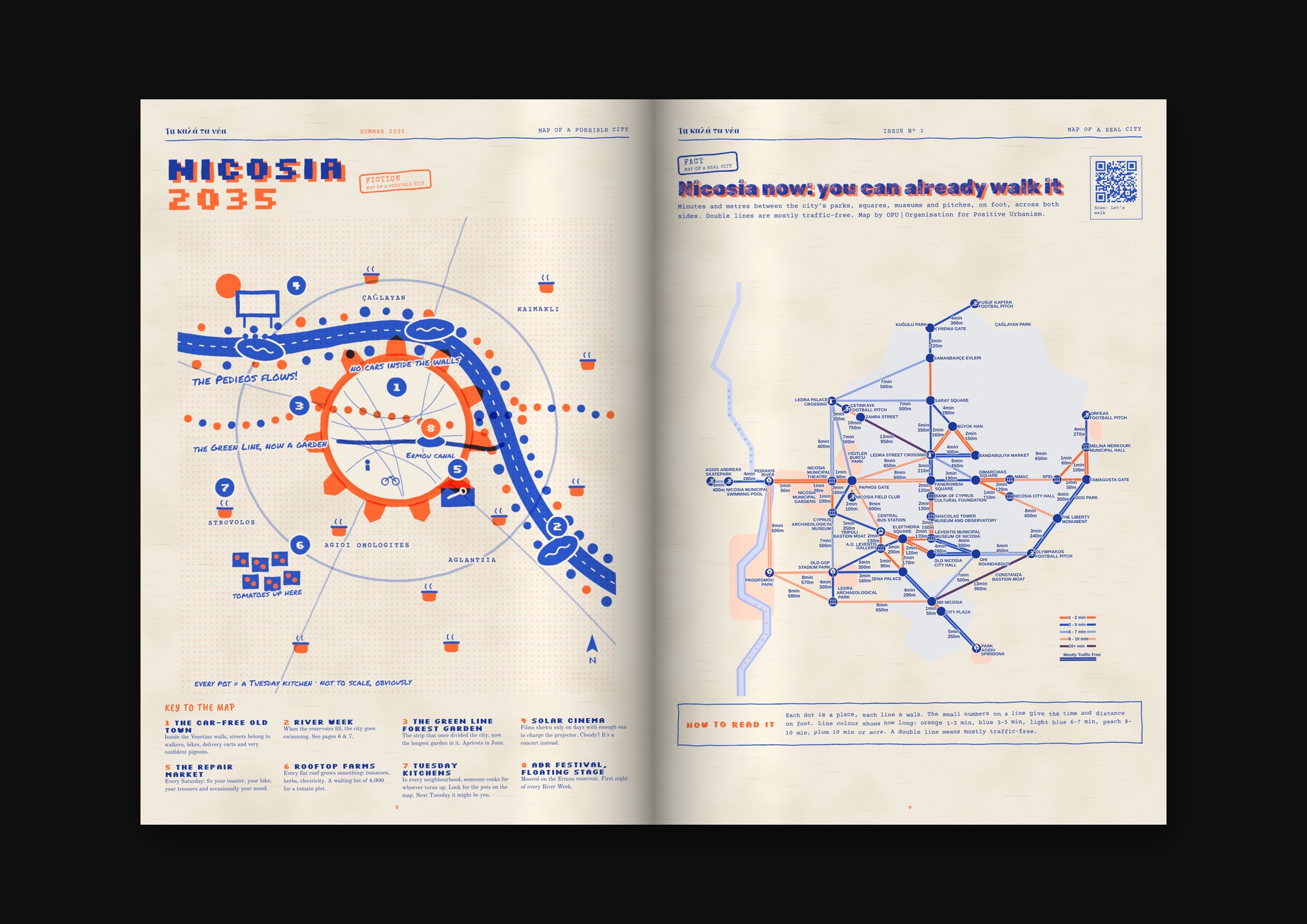
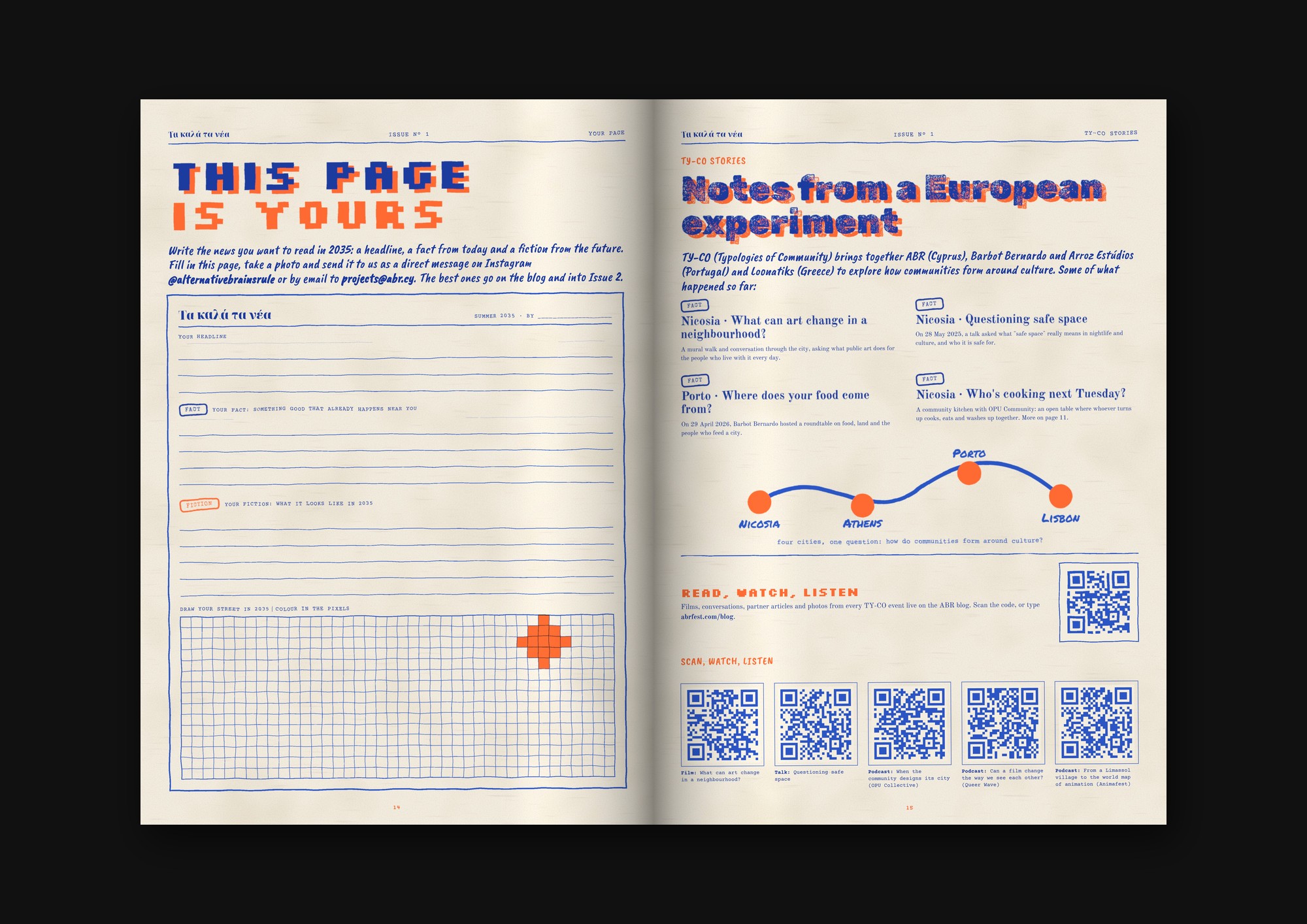
The news is what we make it
More put Utopia on an island that does not exist. Our island exists, with a capital still divided in two. And yet, eutopia is already starting in small places: in gardens we plant today for the future, in festivals the neighbourhoods make themselves, in community kitchens where someone cooks and everyone eats.
We’re not asking you to believe everything will be fine. We’re asking you to imagine what it would be like if it were. Then cook something. Put a chair outside. Walk the route you drive every day.
The future isn’t something that will happen to us. It’s a story we write together. See you in Issue 2. Write a piece of it too.
The ABR team
Read the paper
Printed copies are free to pick up at coffee shops around Lefkosia. Or flip through all 16 pages online: Τα καλά τα νέα, Issue Nº 1 →
Your page to print and the Instagram story template are on the gazette’s blog post →
Read the original article in Greek on Sigmalive →
Original article: The ABR team, «Ου-τόπος ή ευ-τόπος; Γιατί χρειαζόμαστε καλύτερες ιστορίες για το μέλλον», Sigmalive, 30 October 2026.
Instagram: @alternativebrainsrule
Newsletter: subscribe on Substack
TY-CO (communities in conversation) · ABR|Alternative Brains Rule · Co-funded by the European Union
Funded by the European Union. Views and opinions expressed are however, those of the author(s) only and do not necessarily reflect those of the European Union or the European Education and Culture Executive Agency (EACEA). Neither the European Union nor EACEA can be held responsible for them.